Basic science goes hand in hand with technological progress, the ultimate source of economic growth. We need to know not only what works (technology) but also why it works (science). Once we know why, we can continue to build on previous knowledge to find what else works.
Moreover, as many of us learned from the great economic historian Nathan Rosenberg, learning what works often teaches us why. That is, scientific breakthroughs often come from dealing with practical business problems, as when Pasteur made the discoveries that created the foundations for modern medicine and microbiology while looking for solutions to the problem of putrefaction in his family wine business, or when Penzias and Wilson discovered the cosmic background radiation that corroborated the big bang theory of the origin of the universe while exploring the possibility of satellite communication for the AT&T corporation. In short, economic progress without science is as likely as winning a marathon on one leg.
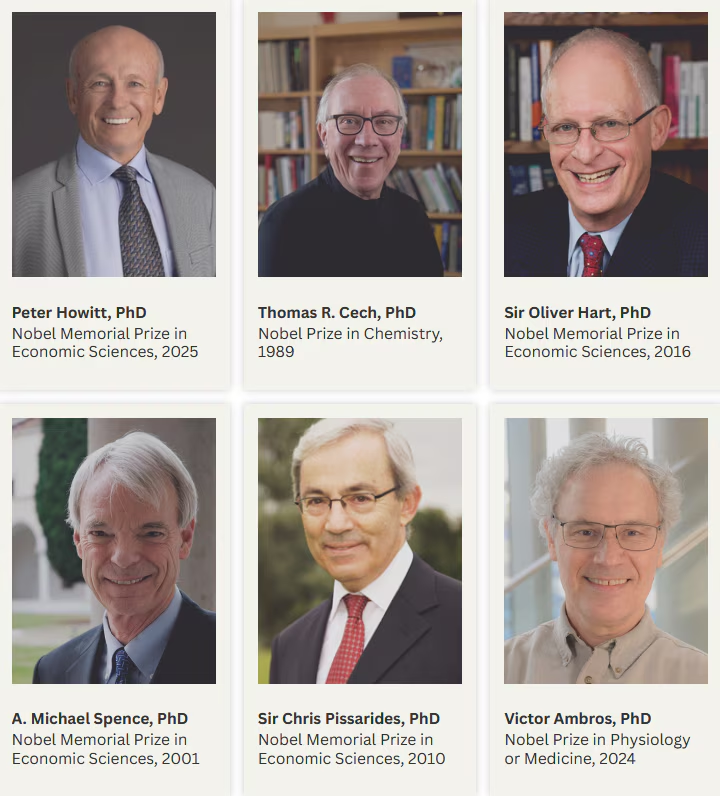
托马斯・R・切赫(Thomas R. Cech, PhD)
1989 年诺贝尔化学奖得主,美国科罗拉多大学波德分校杰出教授
Nobel Prize in Chemistry, 1989
Distinguished Professor, University of Colorado, Boulder, USA
Basic science research, which I prefer to call “discovery science”, is hugely important in the biomedical field. It’s the source of essentially all transformative discoveries. Wait a minute, one might say, isn’t it clinical research that has improved our treatment of cancer, heart disease and metabolic diseases? Yes, medical research is critical. But it’s discovery research that opens completely new fields, because basic scientists choose experimental organisms that allow them to peer into biology much more easily than if they were to study humans. And because all life is connected through evolution, studies of simple organisms typically illuminate features that apply to humans.
As examples, studies of the tiny transparent nematode worm revealed both programmed cell death, now a major paradigm in cancer, and small interfering RNAs, which have been turned into life-saving therapeutics. The pond animal Tetrahymena gave us telomerase, the human version of which is involved in ageing and cancer. And bacteria have given us CRISPR gene editing, promising a whole new approach to treating genetic diseases. Basic research on simple organisms will continue to power biomedicine in the future, as it has in the past.
奥利弗・哈特爵士(Sir Oliver Hart, PhD)
2016 年诺贝尔经济学奖得主,美国哈佛大学经济学系教授
Nobel Memorial Prize in Economic Sciences, 2016
Professor, Department of Economics, Harvard University, USA
数学家 G.H. 哈代有句名言,说自己从未做过任何有用的事。但他错了。他在纯数学领域的研究后来被发现有许多应用,这些应用是他未曾预见的。这就是基础研究如此重要的原因。人们以无法预料的方式在其基础上进行拓展,从而带来能够改变我们所有人生活的实际发现。想想 DNA 结构的发现所产生的影响就知道了。
The mathematician G.H. Hardy famously said that he had never done anything useful. But he was wrong. His work in pure mathematics later turned out to have many applications; ones he did not foresee. And this is why basic research is so important. People build on it in ways that cannot be anticipated and that lead to practical discoveries that can change all our lives. Just think of the impact of the discovery of the structure of DNA.
The value of basic research is one of the reasons universities matter. This is where most of it is carried out, and there is a reason for that. It’s not that the public sector has a long-term perspective compared to the private sector. Rather, it’s because basic research cannot and should not be patented, since its value comes from everyone having access to it. The result is that you can’t easily make money from basic research, only from its applications. Given the vital role universities play in supporting basic research, cutting university funding, so much in vogue these days, is incredibly short-sighted and damaging. Its effect will be long-lasting.
它的重要性体现在两个方面。人类往往充满好奇心,希望了解自身和所处的环境,因此它满足了人类的一种基本欲望。其次,基础研究以及接受相关训练的学生,共同构建了不断拓展的基础,企业和投资者正是在此基础上开发出许多新的有价值的产品和服务。对 DNA 结构发现起到推动作用的研究便是一个很好的例子。
Basic science research refers to scientific inquiry that aims to understand the various aspects of the world we live in. It is not specifically product-focused, has unknown and unpredictable practical applications, and often very long-term potential benefits in terms of future products and services. As a result, it is not generally undertaken by companies or investors seeking a return on investment. Normally, it is publicly funded, and the results are published and available to all. In other words, the research is non-proprietary.
Its importance has two parts. Humans tend to be curious and to want to understand ourselves and our environment, so it satisfies a basic human desire. Second, basic research and the students who are trained to do it, create the expanding foundation on which companies and investors build many new valuable products and services. The research that led to the discovery of the structure of DNA is a good example.
克里斯・皮萨里德斯爵士(Sir Chris Pissarides, PhD)
2010 年诺贝尔经济学奖得主,伦敦政治经济学院经济学钦定讲座教授
Nobel Memorial Prize in Economic Sciences, 2010
Regius Professor of Economics, London School of Economics and Political Science
As humans we want to be happy, healthy and lead a varied life. From early on, we seek to satisfy our curiosity, discover something new and engage with others. This is not how it used to be. For thousands of years, the only concerns of humanity were food and shelter. This change was brought by sustained economic growth driven by technology, which we can now see in industrial machinery, our kitchen appliances and our computers. But these advances did not appear suddenly – they were discovered only because their inventors could stand on the shoulders of the giants of basic science.
Much basic research leads nowhere. When Einstein died, his desk was full of papers with notes. They were not all hiding important new ideas. But occasionally some brilliant mind sees an application in there and converts the basic science into simple practical tools that we all understand and use to improve our lives. Without basic science, our preoccupation would still be food and shelter; it is sad that some people in the world are still not able to enjoy the fruits of its amazing discoveries.
维克多・安布罗斯(Victor Ambros, PhD)
2024 年诺贝尔生理学或医学奖得主,美国马萨诸塞大学医学院自然科学西尔弗曼讲席教授、分子医学教授
Nobel Prize in Physiology or Medicine, 2024
Silverman Chair in Natural Sciences and Professor of Molecular Medicine, University of Massachusetts Medical School, USA
Nature presents us with endless mysteries that pique our curiosity, causing us to apply the tools of science to figure things out, which leads to new understanding of the workings of nature, which in turn enables us to invent novel tools, medicines and materials that improve the lives of people. The history of science attests to the fact that curiosity-driven basic research invariably leads to unexpected and useful new knowledge that engineers can transform into progressive innovations.
This process happens for all fields of science. Examples from biology include studies of nematode development that led to novel therapeutics and novel understanding of cancer, and studies of Gila monster feeding that led to revolutionary new weight-loss drugs. At this moment, on all seven continents, scientists are asking questions and gathering data and making breakthroughs yielding fundamental new understanding of our world and ourselves. This enterprise will (should!) continue indefinitely, as there is much to learn about nature, and what we learn will save us. Basic science research brings hope to the human condition.